
Practical questions
Reading a Weight-Loss Study: Averages Are Not Your Forecast
A headline saying a group lost weight may be accurate while still leaving out information you need for a decision. The average result does not tell you what every participant experienced or whether the intervention fits your circumstances. Read the question the study answered before using its number as a personal deadline.
General information for adults. Not a substitute for medical assessment.
Find the study rather than only the advertisement
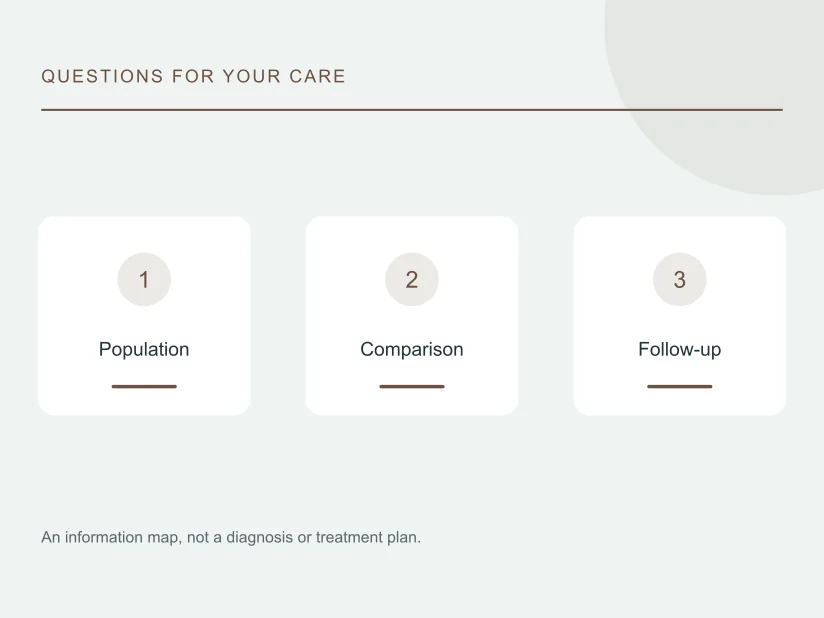
Ask for the publication or study record behind the claim. A testimonial, laboratory finding and controlled clinical trial answer different kinds of question. Check whether the people studied resemble the group the headline addresses, and whether important health conditions were excluded. The word research does not remove the need to understand what was actually tested and what outcome was measured.
Read the comparison and the time period
Consider what the intervention was compared with, what support participants received and when the result was recorded. A short observation cannot by itself establish long-term maintenance. An average may also conceal a range of responses or people who stopped participating. These are reasons to read carefully, not to dismiss every study or to assume the largest advertised result is typical.
Source: NIH: Understanding clinical research · NIDDK: Choosing a safe weight-loss programme
Include safety and relevance in the conversation
Ask about unwanted effects, uncertainty and whether the evidence applies to the exact programme or procedure being offered. Even a well-conducted study does not replace a personal assessment. Avoid using a published number to justify increasing restriction or changing prescribed treatment yourself. A clinician can help separate a useful research finding from a marketing promise about your own future.
Source: NIDDK: Choosing a safe weight-loss programme · WHO: Patient safety
Common questions
Does the average describe every participant?
No. Individual results can differ, and the average alone does not show the full range or uncertainty.
Is a research headline enough to choose treatment?
No. Read the actual evidence and discuss personal suitability, alternatives and safety.
Can I bring a study to an appointment?
Yes. Bring the original link or publication and the exact question you want clarified.
Sources and information limits
Sources support general medical principles, not the UAE booking policies or service availability. Confirm instructions and local arrangements with the care provider. The update date does not claim clinician review.
Content policy and review statusQuestions before arranging an appointment?
Enquire about the next steps and availability. An enquiry does not confirm a booking or diagnosis and is not an emergency service.